Ethereum’s $8B Tokenized Treasuries Breakthrough: How L1 and L2 Are Shaping the Future of Onchain Finance
3-Point Summary
- Developments such as Tokenized Treasuries, stablecoins, the Stripe–Celo strategy, and national stablecoin initiatives all converge toward a single direction: the integration of real-world payments with onchain financial infrastructure.
- Ethereum L1 is emerging as the settlement and issuance layer for governments and institutions, while L2s are becoming the execution layers where real economic activity—payments, DeFi, and applications—takes place.
- The national L1 + bank-operated L2 model is rapidly becoming a realistic blueprint for next-generation financial infrastructure, signaling that onchain finance is moving beyond experimentation into regulated, institutional adoption.

60-Second Shorts Video
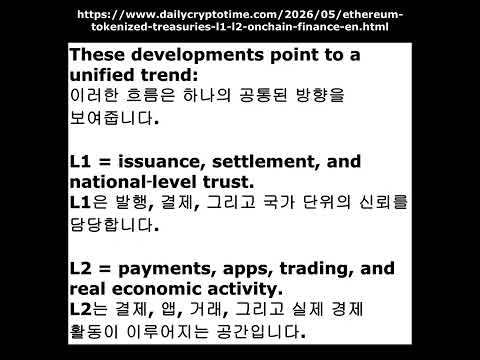
Watch the 60-second video to understand the key onchain finance shift before diving into the full analysis below.
A Comprehensive Look at the Onchain Financial Shift: From Tokenized Treasuries to Stablecoins, Stripe–Celo Strategy, National Stablecoins, and Bank L2 Models
👉 This article builds on the previous analysis, “The Future of Digital Financial Infrastructure: Why L1 Fragmentation Fails and L2 Becomes the Best Business Model” . Reading it first will help you better understand the flow of this article and the structural evolution of L1 and L2.
Tokenized real-world assets (RWAs) have grown more than 10x over the past two years, surpassing $30B — with over 50% concentrated in U.S. Treasury debt. This week, a major milestone was reached as tokenized U.S. Treasuries on Ethereum exceeded $8 billion for the first time.
In addition, Stripe expanded its native stablecoin BRIDGE to Celo, and Canada announced plans for its first regulated fiat-backed stablecoin issued on Ethereum.
These three developments may appear unrelated, but they point to a single trend: a financial ecosystem where “real-world payments + onchain financial infrastructure” are becoming seamlessly integrated.
This shift goes beyond payment innovation. It reflects a structural transformation in which Ethereum L1 functions as the settlement layer, while L2s operate as the real-use and execution layers. Canada’s move also signals the emergence of a global benchmark for how nations may choose their onchain settlement layer.
Onchain finance is no longer an experiment— it is rapidly evolving into a next-generation financial infrastructure involving governments, banks, corporations, and individuals.
To understand this transformation, we must examine five key areas:
- How Tokenized Treasuries are used across L1 and L2
- How stablecoins function differently on L1 vs L2
- Stripe’s BRIDGE stablecoin and Celo’s L1/L2 transition strategy
- Canada’s regulated stablecoin framework
- The national L1 + bank L2 model as a blueprint for future financial infrastructure
1) Tokenized Treasuries: How L1 and L2 Are Actually Used
Tokenized U.S. Treasuries have become a core asset in onchain finance (RWA). But L1 and L2 serve fundamentally different roles.
L1 (Ethereum Mainnet): Issuance, Custody, and Auditing
Most tokenized Treasuries are issued and held on L1.
- BlackRock BUIDL
- Franklin Templeton BENJI
- Ondo Finance OUSG
Institutions require maximum security and regulatory alignment, so L1 acts as the “vault layer.”
L2: The Center of Real Usage, Trading, and DeFi Activity
Once issued, these assets increasingly move to L2 for actual financial operations.
- Base: corporate treasury operations, RWA hub
- Arbitrum: Aave/Maker collateral, Pendle yield markets
- OP Stack ecosystems: RWA-friendly infrastructure
- Polygon: enterprise RWA solutions
Key use cases include:
- Collateralized lending
- Yield tokenization
- Corporate treasury management
- DeFi liquidity provisioning
L1 = issuance & custody, L2 = operating layer.
2) Stablecoins: How L1 and L2 Serve Different Purposes
Stablecoins show an even clearer division between L1 (issuance & settlement) and L2 (real-world usage).
L1: Issuance, Redemption, and Large-Scale Transfers
USDC, USDT, DAI and others are minted and burned on L1.
- Minting/redemption
- Large institutional transfers
- Reserve management
L1 is the foundational layer for stablecoins.
L2: Payments, DeFi, Apps, and Microtransactions
Most stablecoin transactions occur on L2.
- Retail payments
- DeFi trading
- In-app payments
- Gaming/social microtransactions
- Cross-chain routing
Base, Arbitrum, Optimism, and Polygon all show far higher stablecoin activity than L1. L2 is the “real-use layer.”
3) Stripe’s BRIDGE Stablecoin and Celo’s L1/L2 Strategy
Stripe’s expansion of BRIDGE to Celo is not a simple chain integration. It reflects the alignment between Celo’s strategic transition and Stripe’s global payment ambitions.
Celo: From L1 to an Ethereum L2
Originally a mobile-first L1, Celo is transitioning to an OP Stack–based Ethereum L2 (2023–2025).
Why Stripe Chose Celo
- Payment-friendly UX
- Fast and low-cost transactions
- Full Ethereum compatibility
- Global scalability
This makes Celo an ideal environment for BRIDGE × Celo = real-world payments + Ethereum financial infrastructure.
Celo’s Roadmap Shows the Future of L1 + L2 Integration
Celo is not simply “moving from L1 to L2.” It is building a hybrid model combining:
- L1 strengths: speed, low cost, mobile-first UX
- L2 strengths: Ethereum security, EVM liquidity, interoperability
The result is a future ecosystem where real-world payments and onchain finance operate seamlessly together.
4) Canada’s Regulated Stablecoin — Accelerating Onchain Institutional Finance
Canada’s OSFI has been developing a regulated fiat-backed stablecoin framework (2023–2025).
It includes:
- 1:1 reserve requirements
- Issuer registration
- Transparent auditing
- Consumer protection standards
Canadian fintech firms are preparing to issue a CAD stablecoin on Ethereum, likely becoming North America’s first regulated onchain fiat currency.
This signals:
- Nations are choosing Ethereum as their settlement layer
- This sets a precedent for other countries
- Onchain finance is merging with traditional finance
- Ethereum L1 is becoming a national/institutional settlement layer
5) National L1 + Bank L2 Model — A Blueprint for Future Financial Infrastructure
Using Korea as an example, we can clearly see how a national stablecoin system could operate across L1 and L2.
① Bank of Korea Issues a National Stablecoin on Ethereum L1
Imagine the Bank of Korea issuing a KRW-on-chain stablecoin (1:1 backed) on Ethereum L1.
L1 would handle:
- National currency issuance and settlement
- Maximum security and transparency
- Global liquidity access
- Cross-border payments and trade settlement
Ethereum L1 = national settlement layer.
② Commercial Banks Operate Their Own L2 Rollups
Major Korean banks (KB, Shinhan, Hana, Woori) could each run their own L2 rollup.
- KB Rollup
- Shinhan Rollup
- Hana Rollup
- Woori Rollup
These L2s would handle:
- Retail payments, payroll, utility payments
- Onchain savings, loans, collateral products
- Corporate treasury and real-time accounting
- Instant interbank settlement
Ethereum L2 = bank-level execution layer.
③ Why This Model Is Powerful
- Interbank delays → instant settlement
- Lack of transparency → onchain auditability
- High remittance costs → near-zero fees
- Fragmented bank systems → L1-based interoperability
④ Global Implications
This model could become a global template for national stablecoin infrastructure.
National L1 + Bank L2 + Corporate/Consumer App Layer forms a realistic blueprint for the future of global onchain finance.
Conclusion: The Structure of Onchain Finance Is Already Being Rewritten
From tokenized Treasuries and stablecoins to Stripe–Celo integration, to Canada’s regulated stablecoin, to the national L1 + bank L2 model—
All signs point to one conclusion:
Ethereum is becoming the global settlement layer (L1), and L2s are becoming the execution layers where real economic activity happens.
A next-generation financial infrastructure— connecting nations, banks, corporations, and individuals— is already taking shape onchain.
Younchan Jung
Researcher exploring structural shifts in AI, blockchain, and the on‑chain economy.
If you would like to read this article in Korean, please click the button below.