After the CLARITY Act, Stablecoins Begin to Seize the Payment Market
3-Point Summary
- The CLARITY Act establishes a clear rule: deposit-like interest for stablecoins is banned, but on‑chain, usage‑based rewards are allowed.
- This compromise reduces securities-law risk for stablecoins and formally recognizes on‑chain economic activity within the regulatory perimeter.
- With regulatory clarity, stablecoins gain a structural advantage over tokenised deposits in growth, extensibility, and payment‑layer adoption.

60-Second Shorts Video
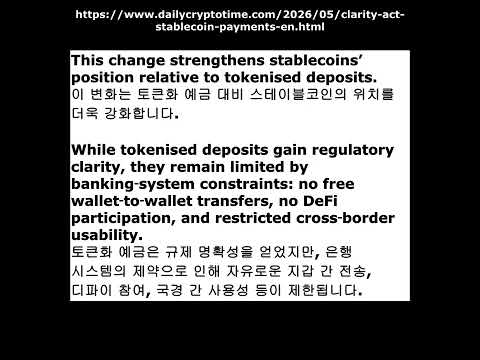
Watch the 60-second video to understand why the CLARITY Act stalled before diving into the full analysis below.
After the CLARITY Act, Stablecoins Begin to Seize the Payment Market
The CLARITY Act, a key digital asset market bill in the U.S. Senate, has reached a pivotal compromise on stablecoin regulation. Lawmakers drew a clear line against “interest payments that make stablecoins resemble bank deposits”, while simultaneously allowing on‑chain, usage‑based reward models.
This is more than a minor regulatory adjustment. It effectively opens the door for stablecoins to become a core settlement and payment layer within the regulated financial system, signaling a potential shift in competitive dynamics across the global payments market. This article analyzes how the compromise affects both stablecoins and tokenised deposits, and what structural changes it may trigger in the payment landscape.
For deeper context, it is helpful to first read The Future of Digital Money: Stablecoins vs. Tokenised Deposits to understand the structural differences between the two assets, and then The Growth of Stablecoins and Their Share of M2: Analyzing the Potential to Disrupt the Payment Market which examines current stablecoin growth rates and two linear models under specific conditions. With that background, the implications of the CLARITY Act compromise and its impact on the payment market become much clearer and more multidimensional.
1) The CLARITY Act compromise on stablecoins in the U.S. Senate
Under the compromise, stablecoin issuers are prohibited from paying interest in a manner resembling bank deposits, but are allowed to offer on‑chain, usage‑based rewards such as:
- Rewards based on payment volume and transaction activity
- Incentives tied to lending, liquidity provision, and other platform activities
- Network participation and protocol‑level reward mechanisms
This approach reduces securities‑law risk for stablecoins and moves toward recognizing on‑chain economic activity within the regulatory perimeter. Industry leaders such as Coinbase have welcomed the compromise as “a pragmatic step to preserve U.S. innovation competitiveness.”
2) With these rules, which wins: stablecoins or tokenised deposits?
Both assets gain clearer roles within the regulated system, but in terms of growth potential and extensibility, stablecoins hold a structural advantage. Tokenised deposits benefit from regulatory clarity, yet remain constrained in how deeply they can integrate with open, on‑chain native finance.
2‑1) Stablecoins: lower regulatory risk + on‑chain rewards → accelerated growth
① Reduced securities‑style risk
By banning deposit‑like interest, the compromise removes the central question of
“Are stablecoins effectively bank deposits?” from the regulatory debate.
② On‑chain reward models explicitly allowed
Usage‑based rewards tied to payments, lending, and liquidity provision are permitted,
strengthening the role of stablecoins in the DeFi, Web3, and AI agent economies.
③ Global usability preserved
Wallet‑to‑wallet transfers, borderless payments, and participation in on‑chain finance
remain core advantages of stablecoins.
④ Institutional adoption becomes easier
With clearer rules, payment companies, fintechs, remittance providers, and asset managers
can more comfortably adopt stablecoins as a settlement and payment layer.
2‑2) Tokenised deposits: regulatory clarity, but limited extensibility
Tokenised deposits are essentially digital representations of bank deposits. They are stable and well‑regulated, but compared to stablecoins they face structural limitations.
① Not freely transferable across open on‑chain environments
Because they are tied to bank accounts, tokenised deposits cannot move freely between wallets.
Moving them outside the banking system quickly raises regulatory and KYC issues.
② Cannot participate in DeFi
Under current banking rules, tokenised deposits generally cannot be deployed into DeFi protocols,
nor used for liquidity provision, on‑chain lending, or automated Web3 strategies.
③ Limited cross‑border usability
They are bound by national banking regulations. Cross‑border payments require inter‑bank processes and KYC,
making them far less frictionless than stablecoins, which can move “wallet‑to‑wallet” in seconds.
④ Bank account required
Opening an account, passing KYC, and complying with AML checks are mandatory,
creating a high barrier to entry for users with limited access to traditional banking.
⑤ Slower innovation cycle
Operating within the banking regulatory framework means that product and technology innovation
tends to move much more slowly than in the open Web3 ecosystem.
3) How this regulatory shift shapes the future of both assets
Stablecoins
- Lower regulatory and securities‑law risk
- On‑chain rewards align with Web3, DeFi, and AI‑driven economies
- High extensibility across global payments, remittances, gaming, and machine‑to‑machine transactions
- Higher likelihood of adoption by institutions and payment providers
→ Strong structural advantage in both growth and innovation
Tokenised deposits
- High regulatory clarity and strong consumer protection
- Well‑suited for institutions, corporates, and banks
- But relatively distant from open, on‑chain native finance
→ Stable but with limited upside in growth and extensibility
4) Will stablecoins begin displacing traditional payments faster?
If the CLARITY Act recognizes stablecoins as an official payment instrument and allows banks and fintechs to issue stablecoins directly, the pace of adoption in the payment market could accelerate significantly.
① Regulatory clarity → faster integration into payment rails
Visa, Mastercard, PayPal, global remittance providers, and banks now have a clear rationale
for integrating stablecoins into their payment infrastructure.
② Stablecoin share of M2 could grow faster
If we approximate stablecoin growth with a simple linear model, the current trajectory can be expressed as:
Baseline model: y = 0.225x - 4.425
Under the CLARITY Act compromise, the growth slope could plausibly move into the following range:
New models: y = 0.6x - 12 ~ y = 1.0x - 20
This implies a realistic scenario where stablecoins reach 10% of M2 by the early 2030s.
③ 10% of M2 is close to a “dominant position” in payments
At that level, stablecoins could function as a default payment and settlement layer across:
- Global remittances
- E‑commerce and online payments
- B2B and trade settlement
- Automated payments between AI agents and IoT devices
Conclusion: Regulation flips stablecoins into “acceleration mode” in the payment market
The CLARITY Act compromise is a decisive turning point that brings stablecoins into the realm of regulated payment assets. With regulatory clarity, broader issuer participation, on‑chain rewards, and global usability all working together, the trajectory of stablecoin adoption shifts from a simple linear climb to something closer to a quasi‑exponential growth curve.
If stablecoins reach 10% of M2 sooner than previously expected, that moment will not merely reflect a higher market share—it will signal a redistribution of power within the global payment system.
In that sense, the CLARITY Act compromise is less about “allowing a new product” and more about moving stablecoins from the realm of possibility into the realm of inevitability—pushing them into acceleration mode as a core layer of the future payment infrastructure.
Younchan Jung
Researcher exploring structural shifts in AI, blockchain, and the on‑chain economy.
If you would like to read this article in Korean, please click the button below.