The Growth of Stablecoins and Their Share of M2: Analyzing the Potential to Disrupt the Payment Market
3-Point Summary
- Stablecoins are growing quickly, but at the current pace they cannot replace the payments market anytime soon.
- When stablecoins reach a 10% share of M2, this can correspond to roughly 60–100% of the payments-focused M1, effectively giving them dominance over the actual payments market.
- Regulatory clarity, payment‑system integration, and global demand for on‑chain dollars are the key factors that could accelerate stablecoin adoption.

60-Second Shorts Video
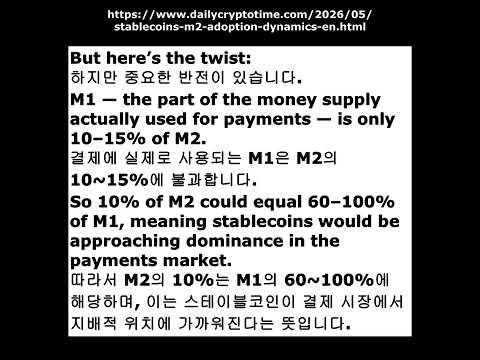
Watch the 60-second video to understand why stablecoins could dominate the payments market long before reaching 10% of M2.
📌 Can the Growth of Stablecoins Really Change the Payments Market?
How Stablecoins Are Eating into M2
Over the past few years, the growth of stablecoins has been remarkably fast.
In 2020, their share was effectively 0%, but by 2026 stablecoins have reached about 1.4% of U.S. M2.
Looking at this chart alone, it’s easy to think, “Aren’t stablecoins about to disrupt the entire payments market?”
However, when we analyze the data more calmly, the conclusion is a bit different.
At the current growth rate, it will still take a very long time for stablecoins to truly replace the existing payments system.
If you read the previous article, “Stablecoins and Tokenized Assets: The Rise of a New Financial Standard in 2026”, alongside this one, it will help you better understand the broader context and the new financial structure that stablecoins are beginning to create.
1) Why the Current Growth Rate Makes Payment Market Replacement Nearly Impossible
Let’s first examine the recent trend.
From 2020 to 2026, the share of stablecoins relative to M2 increased steadily:
0% → 0.8% → 1.4%.
The chart shows a gentle but consistent upward slope, indicating that stablecoins are gradually gaining presence within the U.S. money supply (M2).
But when we analyze this growth rate using a linear model, the story changes.
The linear regression equation we calculated is:
y = 0.225x - 4.425
Here, x represents the year (20 = 2020), and y represents the stablecoin share of M2.
Plugging in y = 10%:
x ≈ 64.1
This means stablecoins would reach 10% of M2 around 2064.
💡 But here’s a very important point
10% of M2 does NOT mean 10% of the payment market.
In the U.S. monetary system, only M1 (cash + demand deposits) is used directly for payments.
M1 accounts for only 10–15% of M2.
Therefore:
10% of M2 = 10% of total money supply
But in payment-market terms, this could correspond to 60–100% of M1
In other words, 10% of M2 represents a far larger share of the payment market.
If stablecoins reach 10% of M2, they would be approaching a dominant position in the payment ecosystem.
2) Why Stablecoins Are Slow to Replace Existing Payment Systems
- Regulatory uncertainty
The U.S. has not yet clearly recognized stablecoins as an official payment instrument. - Strong network effects of existing payment systems
Card networks, banks, and payment rails are already globally standardized. - User experience (UX) barriers
Wallet setup, private key management, and gas fees remain difficult for mainstream users. - Lack of merchant incentives
Even with high card fees, card networks handle risk, refunds, security, and accounting.
3) What “Dramatic Changes” Must Occur?
- Regulatory clarity
If stablecoins are recognized as official payment instruments and banks/fintechs can issue them directly, adoption could accelerate rapidly. - Adoption by major payment platforms
Once Apple Pay, Visa, Mastercard, and PayPal natively support on-chain payments, stablecoins will offer a UX indistinguishable from existing payment methods. - Ultra-low gas fees + instant settlement
With L2 scalability, gas fees approach zero and settlement speed reaches card-level performance. - Global demand for on-chain dollars
In emerging markets, trust in stablecoins is already surpassing trust in local banks, accelerating stablecoin supply growth.
4) How Would the Linear Model Change if These Conditions Are Met?
We estimate when stablecoins could reach 10% of M2 — a level that would place them in a near-dominant position in the payment market — under two different scenarios.
The current linear model is:
y = 0.225x - 4.425
But if the dramatic changes above occur, the slope (a) could increase significantly.
Below are two alternative growth scenarios.
Scenario A — Slope (a) = 0.6
Assumptions
· Regulatory clarity
· Banks and fintechs issue stablecoins
· Visa/Mastercard/Apple Pay support on-chain payments
In short, regulatory integration + payment infrastructure integration.
New linear model
y = 0.6x - 12
10% arrival time
10 = 0.6x - 12 → x ≈ 36.7 → 2036–2037
Scenario B — Slope (a) = 1.0
Assumptions
· All conditions from Scenario A
· Massive global migration to on-chain dollars
· Stablecoins become a de facto savings/payment tool in emerging markets
This represents a structural shift in global finance.
New linear model
y = 1.0x - 20
10% arrival time
10 = x - 20 → x = 30 → 2030
⭐ Summary: How the Linear Model Changes by Scenario
| Scenario | Slope (a) | Conditions | 10% Arrival |
|---|---|---|---|
| Current Trend | 0.225 | No major changes | 2064 |
| Scenario A | 0.6 | Regulatory clarity + payment integration | 2036–2037 |
| Scenario B | 1.0 | Global shift to on-chain dollars | 2030 |
📌 Conclusion
At the current growth rate, it would take over 40 years for stablecoins to reach 10% of M2.
But if regulatory, technological, and global financial shifts occur simultaneously,
growth could shift from linear to an S-curve.
Most importantly:
10% of M2 corresponds to 60–100% of the payment market (M1).
Thus, when stablecoins reach 10% of M2, they may already be approaching a dominant position in payments.
Ultimately, the future of stablecoins depends on
how quickly they integrate into regulatory frameworks and payment infrastructure.
Younchan Jung
Researcher exploring structural shifts in AI, blockchain, and the on‑chain economy.
If you would like to read this article in Korean, please click the button below.