Wall Street’s Choice of Staking ETFs: A Complete Comparison of ETHB and Grayscale Mini ETF
3-Point Summary
- ETHB and the Grayscale Ethereum Staking Mini ETF both provide staking yield, but their staking structures, yield distribution methods, and behavior during price shocks differ fundamentally.
- ETHB absorbs staking rewards into its NAV as price appreciation, while the Grayscale Mini ETF converts rewards into cash and pays them out as quarterly dividends.
- During a sharp ETH price drop, ETHB fully reflects the downside, whereas the Grayscale Mini ETF continues dividend payouts, maintaining a steady cash flow despite market volatility.

20‑Second Shorts Video (Updated August 12, 2026)
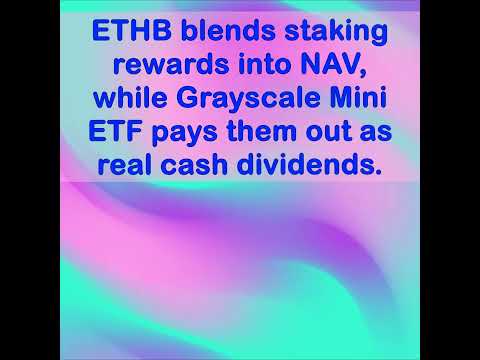
ETHB vs Grayscale: The Real Difference Wall Street Sees in Staking ETFs
#EthereumETF #StakingYield #WallStreetMoves
ETHB vs Grayscale Ethereum Staking Mini ETF: Comparing Staking Structure, Yield Characteristics, and Impact During Price Crashes
ETFs act as a bridge between blockchain networks and traditional financial markets. BlackRock began purchasing actual ETH to seed the iShares Ethereum Trust (ETHB), and ETHB is not a simple spot-holding ETF. Instead, it directly stakes the ETH it holds to generate yield and distributes that yield to investors, pulling Wall Street’s staking model into regulated finance. (Ethereum’s Financial Breakthrough: BlackRock Turns Staking into Wall Street Yield)
This trend accelerated on July 28, 2026, when Morgan Stanley Investment Management (MSIM) launched the Morgan Stanley Ethereum Staking Trust (MSSE) and the Solana Staking Trust (MSOL). Wall Street began favoring structures where on-chain staking rewards directly influence the value of the financial product, rather than simple price-tracking assets. (Wall Street Has Swallowed Staking: Morgan Stanley Opens the Era of Institutional Staking)
Europe is following the same pattern. Intesa Sanpaolo reduced its Bitcoin exposure and shifted toward Ethereum staking—choosing a structure where on-chain yield translates into real financial performance, rather than relying solely on price movements. (Intesa Sanpaolo’s Shocking Move: Slashing Bitcoin and Pivoting to Ethereum Staking)
Amid this global institutional staking trend, Grayscale submitted the second amendment for its Ethereum Staking Mini ETF to the SEC, strengthening the design so that—if certain tax conditions are met—the ETF can directly stake nearly all ETH it holds. Staking rewards are converted to cash and paid out as quarterly dividends, clearly distinguishing it from traditional spot ETFs that simply hold ETH. If approved, this ETF could give Grayscale a competitive edge over BlackRock and Fidelity in institutional ETH staking participation. Market attention is also focused on the upcoming disclosure of staking fees.
As institutional-grade Ethereum investment products rapidly evolve, BlackRock’s ETHB (iShares Staked Ethereum Trust) and Grayscale’s Ethereum Staking Mini ETF both provide staking yield—but they deliver completely different investment experiences in terms of staking structure, yield distribution, and behavior during price shocks.
1) Fundamental Differences in Staking Structure
A. ETHB — A trust holding already-staked ETH
ETHB is a Grantor Trust that holds ETH that is already staked. Staking is performed through external validator infrastructure (e.g., Coinbase), and rewards are reflected in the NAV. In other words, ETHB provides “indirect economic exposure to staked ETH.”
B. Grayscale Ethereum Staking Mini ETF — An ETF that directly stakes ETH
The Grayscale Mini ETF directly stakes the ETH it holds. Staking rewards are converted to cash and paid as quarterly dividends. Investors experience a structure where staking yield becomes direct cash flow.
2) Nature of Yield Delivered to Investors
A. ETHB — Yield absorbed into price
ETHB does not pay staking rewards in cash. Rewards naturally flow into the NAV, causing the ETF price to gradually rise. Investors experience staking yield through price appreciation rather than dividends.
B. Grayscale Mini ETF — Yield paid as cash
The Grayscale Mini ETF pays staking rewards as cash dividends. Dividends arrive quarterly, and the ETF price adjusts afterward. Investors receive staking yield as a visible cash flow.
3) When ETH Price Drops 20%
A. ETHB Investors — Full exposure to price decline
If ETH drops 20%, ETHB’s NAV drops accordingly. Staking rewards are not large enough to offset a sharp decline, so ETHB investors experience pure price downside.
B. Grayscale Mini ETF Investors — Price decline + dividend continuity
The Grayscale Mini ETF also declines in price, but quarterly dividends continue. While dividends cannot fully offset a crash, investors still experience “price decline + dividend continuity,” maintaining a steady cash flow even during downturns.
Conclusion
ETHB and the Grayscale Mini ETF both provide ETH staking yield, but the investor experience is fundamentally different. ETHB delivers price-based yield, while the Grayscale Mini ETF delivers cash dividend yield. During sharp ETH price declines, ETHB fully absorbs the downside, whereas the Grayscale Mini ETF maintains dividend flow.
As institutional Ethereum investment products diversify, investors should clearly distinguish these two products based on one key question: “In what form do you want to receive staking yield?”
Younchan Jung
Researcher exploring structural shifts in AI, blockchain, and the on‑chain economy.
If you would like to read this article in Korean, please click the button below.