Morgan Stanley’s View of Ethereum: The Completed Financial Infrastructure
3-Point Summary
- Morgan Stanley identifies Ethereum as core financial infrastructure built on programmability, decentralization, ecosystem depth, and adaptability.
- Institutions choose Ethereum because assets, liquidity, and institutional participation have converged into an unreplicable network effect.
- Data across stablecoins, RWAs, DeFi, and enterprise adoption shows that the future of global finance is already being built on Ethereum.

20‑Second Shorts Video (Updated August 15, 2026)
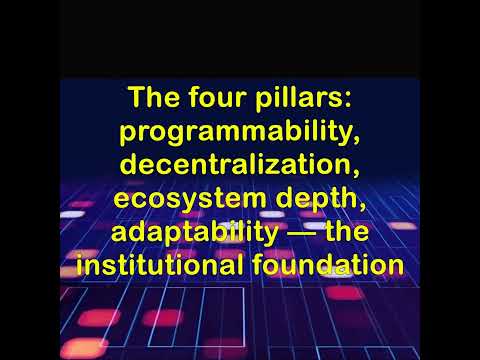
The Moment Morgan Stanley Declared Ethereum as Core Financial Infrastructure #Ethereum #MorganStanley #OnchainFinance #DailyCryptoTime
Why Ethereum Became Financial Infrastructure: Morgan Stanley and Institutional Choice
A recent report published by Morgan Stanley Investment Management makes it clear that Ethereum is no longer just a cryptocurrency platform but the core infrastructure of the future financial system.
Morgan Stanley identifies four key elements that explain why Ethereum has become financial infrastructure: programmability, decentralization, ecosystem depth, and adaptability. These four pillars form the structural foundation behind why global institutions choose Ethereum.
Combined with the summary provided by Etherealize on X, the structural reasons behind institutional adoption of Ethereum become even clearer.
1) The Four Core Elements Morgan Stanley Sees in Ethereum
Morgan Stanley explains Ethereum’s rise as financial infrastructure through four core elements. Below are the most important structural characteristics, along with DCT’s analysis for each.
-
(1) Programmability
- Morgan Stanley Summary — Ethereum is evaluated as a programmable financial infrastructure capable of automating stablecoins, RWAs, payments, settlements, and financial applications through smart contracts. The ability to encode complex financial structures directly into code is the core advantage.
- DCT Analysis — DCT views this not merely as automation but as the ability to express large-scale financial contracts and RWA structures on-chain. Ethereum L1 provides global settlement, security, and liquidity, while L2 delivers high-speed execution. This aligns with the model explained in the previous article “RWA, High-Speed, Large Contracts: How Robinhood L2 Sets the Retail Onchain Standard” , forming the foundation of the “L1 settlement + L2 execution” architecture.
-
(2) Decentralization
- Morgan Stanley Summary — Operating without a central authority eliminates counterparty risk and ensures neutrality and trust in global financial infrastructure.
- DCT Analysis — The Ethereum Foundation (EF) does not operate the network, run validators, or exert control through large ETH holdings. Community operation + EF guidance creates a governance structure that structurally avoids centralization risks, unlike other chains. This is detailed in the previous article “The Real Face of Decentralization: How Ethereum Avoided the Trap of Centralization” .
-
(3) Ecosystem Depth
- Morgan Stanley Summary — Ethereum hosts the deepest concentration of stablecoins, RWAs, DeFi, and financial applications, forming the center of onchain finance.
- DCT Analysis — The most important indicator of this depth is Ethereum’s $310B TVL. This number is not just current capital—it signals the expansion potential of onchain finance in 2027, driven by staking, L2 growth, RWAs, and LRTs. Detailed analysis is available in the previous article “From ETH Staking to RWA: The Six Forces Behind Ethereum’s $310B TVL” .
-
(4) Adaptability
- Morgan Stanley Summary — Ethereum continues to strengthen its role as global financial infrastructure through improvements in scalability, efficiency, and security.
- DCT Analysis — L1 serves as a permissionless global settlement layer, while L2 provides enterprise-grade private execution environments with global interoperability. This reflects the final form of Web3 described in the previous article “The Internet Already Knew the Answer: The Final Form of Web3 Once Sustainable L1 Funding Arrives” , built on the “Permissionless L1 + Private L2” model.
These four elements demonstrate that Ethereum is no longer just a technology platform but has become the global financial infrastructure layer (L1).
2) Why Institutions Choose Ethereum: The Network Effect
Assets converge where liquidity exists.
Liquidity converges where assets exist.
Institutions converge where both already exist.
As summarized by Etherealize, this captures the essence of finance. Over the past decade, Ethereum has accumulated all three network effects: assets → liquidity → institutions. These network effects cannot be replicated.
3) The Future of Finance Is Already Being Built on Ethereum
The claim that future finance is being built on Ethereum is not emotional—it is supported by quantitative data.
- Stablecoins: Over 70% of the ~$160B market is Ethereum-based
- Tokenized RWAs: Over 85% of ~$11B are on Ethereum/EVM
- DeFi TVL: Ethereum holds $45B (50%+), and 75%+ including L2s
- Institutional adoption: BlackRock, Franklin Templeton, JPMorgan, Visa, Mastercard, PayPal—all use Ethereum-based infrastructure
All data points to one conclusion: The future of finance is already being built on Ethereum.
Conclusion
Morgan Stanley defines Ethereum as “core financial infrastructure,” supported by programmability, decentralization, ecosystem depth, and adaptability. Etherealize summarizes this as a single concept: an unreplicable network effect.
Though expressed differently, both perspectives point to the same conclusion: Ethereum possesses not only technological superiority but also structural, economic, and governance foundations that make it the standard infrastructure of onchain finance.
Ethereum is already at the center of future finance,
and global institutions are building the next financial system on top of it.
Younchan Jung
Researcher exploring structural shifts in AI, blockchain, and the on‑chain economy.
If you would like to read this article in Korean, please click the button below.