30% of Global Spot Volume: The Hidden Risks in South Korea’s Crypto Market
3-Point Summary
- South Korea accounts for 20–30% of global spot volume, yet its market structure differs sharply from global norms.
- The market is heavily concentrated in altcoins, driven by short-term trading and extremely high turnover.
- Restrictions on external wallet transfers reinforce isolated pricing, amplifying risks such as the Kimchi Premium.

60-Second Shorts Video
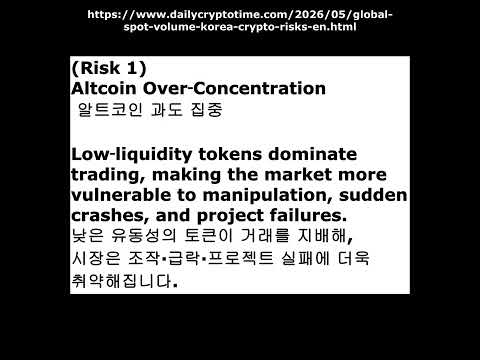
Watch the 60-second video to understand the core risks before diving into the full analysis below.
Structural Risks in South Korea’s Crypto Market: Why Now Is the Time to Talk
South Korea’s crypto market accounts for roughly 20–30% of global spot trading volume, making it one of the largest markets in the world. However, its structure differs significantly from global norms. The table below compares the market structure of Korean exchanges with that of Binance, the world’s largest crypto exchange.
| Item | Korean Exchanges | Binance |
|---|---|---|
| Weekly Spot Volume (USD) | 10B ~ 100B | 40B ~ 200B |
| Share of Global Spot Volume | Approx. 20% ~ 30% | Approx. 50% ~ 60% |
| BTC Share | 5% ~ 10% (Very Low) | 25% ~ 35% (High) |
| ETH Share | 10% ~ 20% (Medium) | 10% ~ 20% (Medium) |
| Altcoins Share | 70% ~ 85% (Very High, Highly Concentrated) | 45% ~ 60% (High but More Diversified) |
| Market Character | Speculative, Altcoin-Centric | Global, Liquidity-Centric |
This table shows that the Korean market is not just an active market, but a structurally unique and high-risk market. In particular, extreme altcoin concentration, short-term trading behavior, and restrictions on external wallet transfers are interconnected, creating a set of risks that are specific to Korea. Below, we examine these structural issues from three angles.
1) An Altcoin-Heavy Market Structure Over BTC and ETH — A Fundamental Threat to Investor Safety
South Korea is one of the few markets in the world where altcoins account for as much as 70–85% of trading volume. By contrast, in the global market (especially on Binance), BTC and ETH together make up around 40–55%.
This structure entails several key risks:
-
① Altcoins have shallow liquidity and are more vulnerable to price manipulation
With smaller market caps, prices can be easily moved by large buy or sell orders, and project risks (such as shutdowns, team exits, or unexpected token issuance) are significantly higher. -
② Volatility is 2–5 times higher than global benchmark assets like BTC and ETH
This structurally increases the probability and scale of investor losses. -
③ The Korean market can act as a ‘bubble generator’ for altcoins
Prices often decouple from global levels, with repeated patterns of sharp rallies followed by steep crashes.
In short, Korea’s extreme tilt toward altcoins represents a structural vulnerability in terms of investor protection and market safety.
2) Extremely High Turnover and Short-Term Trading — Turning Coins into Pure Speculative Assets
The Korean market shows the following characteristics:
- Trading turnover is among the highest in the world
- Some coins see daily trading volume reach 20–40% of their total market cap
- Short-term trading and scalping dominate over long-term holding
This structure raises several concerns:
-
① Prices move more on ‘trading volume’ than on fundamental value
Instead of technology, ecosystem strength, or real-world usage, “how much it trades today” becomes the main driver of price. -
② The market behaves more like a betting arena than an investment venue
Coins are treated less as technology assets and more as speculative chips for short-term gains. -
③ Globally, Korea is increasingly seen as a ‘volatility supplier’
Price spikes and crashes originating in Korea spill over to other markets, undermining the credibility of the Korean market.
Thus, extremely high turnover is not a sign of a healthy, vibrant market, but rather a symptom of a deeply speculative market structure.
3) The Kimchi Premium and Its Structural Link to ‘External Wallet Transfer’ Restrictions
The Kimchi Premium is not just a case of “crypto being more expensive in Korea.” Behind it lies a regulatory structure that plays a crucial role.
-
① Restrictions on sending coins from Korean exchanges to external wallets
For certain coins, external wallet transfers are outright banned, or only pre-registered wallets are allowed. For many new investors, registering an external wallet is difficult or practically inaccessible. -
② Arbitrage via overseas exchanges is hard or impossible
Even when a Kimchi Premium emerges, investors often cannot send coins abroad to sell them, meaning the premium does not naturally close through arbitrage. -
③ As a result, the Korean market develops an ‘isolated price structure’
Prices diverge from global levels and form an independent pricing environment, with particularly large gaps in altcoins. -
④ The Kimchi Premium amplifies altcoin bubbles
In a market cut off from external liquidity, domestic demand alone can push prices excessively high, and when the bubble bursts, the losses are concentrated almost entirely on Korean investors.
In other words, there is a clear structural chain at work: external wallet transfer restrictions → arbitrage becomes impossible → price gaps widen → the Kimchi Premium becomes entrenched.
Conclusion: A Market as Big as Its Responsibility
South Korea is a giant in the global crypto landscape, accounting for 20–30% of global spot trading volume. But its size comes with equally large and complex structural vulnerabilities.
Altcoin concentration, short-term trading dominance, restrictions on external wallet transfers, and the persistence of the Kimchi Premium all interact to create a market structure characterized by high volatility, high risk, and high isolation.
If South Korea is to continue playing a meaningful role in the global crypto ecosystem, it must first confront these structural issues head-on and begin serious discussions on reforms at the levels of regulation, market design, and investor culture.
Younchan Jung
Researcher exploring structural shifts in AI, blockchain, and the on‑chain economy.
If you would like to read this article in Korean, please click the button below.