Why ETH Could Break Out Again in 2028: The Structural Thresholds Driven by Onchain Finance, AI, and RWA
3-Point Summary
- ETH’s stagnant price over the past five years is due to not yet reaching key structural thresholds.
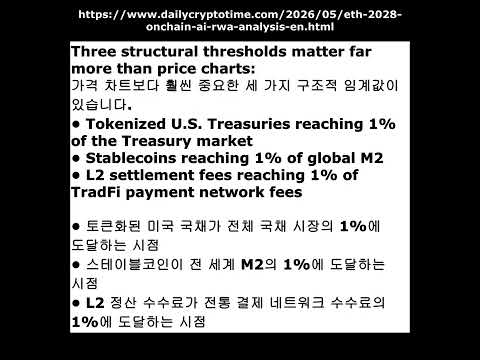
- Three quantitative thresholds — tokenized Treasuries, stablecoins, and L2 settlement fees — are steadily approaching critical levels.
- AI acts as an accelerant that shortens the timeline for ETH to reach these thresholds, making a structural uptrend around 2028 increasingly plausible.

60-Second Shorts Video
Watch the 60-second video before diving into the full analysis below.
🟣 [DCT Analysis] Why ETH Could Enter a Structural Uptrend Around 2028
— 2021 → 2026 → 2030, and the Structural Thresholds Accelerated by AI
🟪 Introduction: Looking Only at ETH’s Price Can Make You Skeptical. But…
In May 2021, the price of ETH was around $3,900, and in May 2026, the price of ETH is around $2,290.
Seeing the price lower after five years, anyone could reasonably think:
“What if ETH is still trading below $5,000 even five years from now?”
However, this article is an analysis written precisely to challenge that skepticism. There are structural thresholds that can drive ETH’s price higher, and we present the reasoning for why those thresholds could be reached around 2028. The key point is that AI is accelerating the path toward those thresholds.
👉 For additional context, you may find it helpful to read the previous article:
•
Beyond Bitcoin 1: Why ETH Is Becoming the New Digital Money (EN)
1) May 2021 — Prologue: A Time When Onchain Finance Was Only a Possibility
- ETH price: $3,900
- Stablecoins: around $100B, mostly used for crypto-native payments
- RWA: effectively 0
- L2: just emerging, still in an experimental phase
- Institutional / sovereign participation: almost none
→ 2021 was a period when only the “possibility” of onchain finance existed.
2) May 2026 — Turning Point: When Onchain Finance Begins to Connect with Traditional Finance
- Total RWA: $30B+
- Share of U.S. Treasuries within RWA: 50%+
- Tokenized U.S. Treasuries on Ethereum: $8B
- Stablecoins: $150B–$200B
- National stablecoin pilots: Canada, Japan, Hong Kong
- Traditional financial institutions (BlackRock, Franklin, Ondo) issuing RWA on Ethereum
- Ethereum L1 = settlement layer / L2 (Base, OP, Arbitrum, Polygon, Celo) = execution layer
→ 2026 is the turning point where onchain finance begins to be integrated into traditional financial infrastructure.
3) Three Structural Thresholds That Can Reprice ETH (Quantitative + % of Threshold Reached)
The moment when ETH is “re-rated into a completely different asset class” should not be judged by price charts alone, but by penetration and market share.
① When Tokenized U.S. Treasuries Reach 1% of the Total U.S. Treasury Market
- Total U.S. Treasury market: $27T
- Threshold: 1% = $270B
- Current onchain amount (as of 2026.05): $8B
- Share of threshold reached: approximately 2.9%
② When Stablecoins Reach 1% of Global M2
- Global M2: $100T
- Threshold: 1% = $1T
- Current onchain amount (as of 2026.05): $150B–$200B
- Share of threshold reached: approximately 15%–20%
③ When Ethereum L2 Settlement Fees Reach 1% of TradFi Payment Network Fees
- TradFi payment network fees: $300B per year
- Threshold: 1% = $3B per year ≈ $8M per day
- Current L2 settlement fees (as of 2026.05): $1M–$2M per day
- Share of threshold reached: approximately 12.5%–25%
4) Six AI-Driven Tailwinds Over the Next Two Years
→ How They Accelerate These Structural Thresholds
AI does not directly push ETH’s price up by itself. However, it acts as a catalyst that shortens the time needed for ETH to reach its structural thresholds.
① Onchain Payments, Investing, and Asset Management by AI Agents
AI cannot hold a traditional bank account → it uses onchain wallets → explosive growth in stablecoin and RWA usage → Accelerates the timeline to the 1% of global M2 stablecoin threshold
② AI-Driven Automated Payments, Subscriptions, and Payroll
As recurring payments are automated, stablecoin payment volume increases → Accelerates the timeline to the 1% L2 settlement fee threshold
③ L2 Adoption by AI Companies (Base, OP Stack, etc.)
A portion of AI API calls settle onchain → Increases L2 transaction volume → brings the 1% threshold closer
④ AI-Based Automated Management of RWA, Treasuries, and Money Markets
AI automatically manages RWA portfolios → Accelerates the timeline to the 1% tokenized U.S. Treasuries threshold
⑤ Convergence of AI × ZK × Regulators
AI computes, ZK proves, regulators approve → Accelerates institutional adoption of RWA and stablecoins
⑥ AI Fully Abstracting the User Experience
Users no longer need to be aware of blockchains; AI automatically selects the optimal L2 and stablecoin → Accelerates both the 1% M2 stablecoin and 1% L2 fee thresholds
🟣 Conclusion: ETH Has a High Probability of Entering a Structural Uptrend Around 2028
The reason ETH’s price appears to have been stagnant over the past five years can be summarized in one sentence: it has not yet reached its structural thresholds.
However, with the growth of RWA, the expansion of stablecoins, the rise in L2 settlement demand, and AI acting as a catalyst that accelerates all of these trends, there is a strong case that ETH could be structurally re-rated around 2028.
→ 2028 may be the year when ETH begins to be revalued as a core asset of global financial infrastructure.
Younchan Jung
Researcher exploring structural shifts in AI, blockchain, and the on‑chain economy.
If you would like to read this article in Korean, please click the button below.