0.01% of a $54 Trillion Market: The Explosive Growth Potential of Tokenized Commodities
3-Point Summary
- Only 0.01% of the $54 trillion global commodities market has been brought on‑chain, indicating that tokenized commodities remain in an extremely early stage.
- Digital Commodities and Tokenized Commodities differ fundamentally in structure, value basis, and regulatory frameworks—differences that are driving the next phase of market expansion.
- The combined infrastructure of Chainlink (trust layer) and Ethereum (settlement and liquidity layer) is rapidly establishing the foundation for large‑scale tokenized commodity adoption.

50-Second Shorts Video
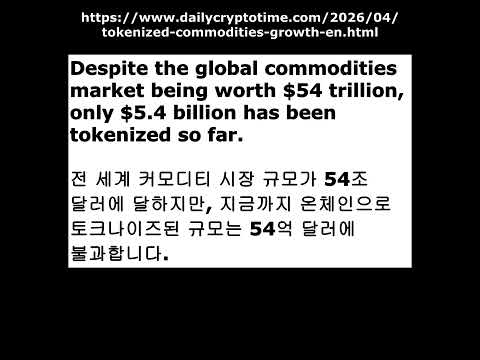
Watch the 50-second video to understand the early signals behind tokenized commodities before diving into the full analysis below.
Early Signals from a Nascent Market: Why Tokenized Commodities Now
※ This article is being published in its current form first and will be updated to the final Daily Crypto Times (DCT) format in two days.
As of 2026, the global commodities market is worth approximately $54 trillion.
However, only about 0.01% of this massive market has actually been brought on-chain.
This tiny slice at an extremely early stage is what we call Tokenized Commodities.
Physical commodities such as gold, silver, copper, and oil are foundational assets for global finance,
yet the way they are traded, settled, and custodied has barely changed for decades.
Now, this structure is beginning to be fundamentally reshaped through Ethereum-based tokenization.
Recent market data highlights an important reality.
The on-chain size of tokenized commodities is only about $5.4 billion,
which is roughly 0.01% of the total market—
implying there is room for growth by several orders of magnitude.
To understand the essence of this shift, this article focuses on:
① The structural differences between Digital Commodities and Tokenized Commodities,
② The latest market size by asset type,
③ The tokenized commodities infrastructure built by Chainlink × Ethereum.
For broader context on this shift, please refer to the previous article:
“The Quiet Conquest of Ethereum: How Stablecoins and Tokenized Assets Are Rewriting the Global Financial Order”
We are standing at the moment when the door to a massive market has just begun to open.
Beyond that door lies a new order that will shape the next decade of global finance.
1. Digital Commodities and Tokenized Commodities
Digital Commodities
Digital Commodities are purely digital assets that exist natively on blockchains, with no underlying physical backing. Their value is derived from network usage, demand, and economic activity. They are classified as commodities rather than securities and generally fall under the jurisdiction of the CFTC. This classification lowers regulatory barriers for institutional participation, ETFs, derivatives, and other large-scale capital inflows.
Examples: ETH, SOL, XRP, ADA, DOGE, AVAX, LINK, DOT, etc.
Tokenized Commodities
Tokenized Commodities are blockchain-based tokens that represent real-world physical assets. Assets such as gold, government bonds, and real estate are backed 1:1, and the token represents ownership or a claim on the underlying asset. Issuers must actually hold the physical asset, and both traditional financial regulation and commodities regulation apply. They are rapidly becoming a core component of the RWA (Real World Assets) market.
Examples: Tokenized gold (PAXG), tokenized U.S. Treasuries (ONDO, USDY), tokenized real estate, etc.
Key differences summary
| Category | Digital Commodities | Tokenized Commodities |
|---|---|---|
| Underlying asset | None (digital-native) | Backed 1:1 by physical assets |
| Source of value | Network usage and demand | Value of the underlying physical asset |
| Regulation | Commodity regulation, primarily CFTC | Mix of physical and financial regulation |
| Key risks | Crypto asset volatility | Physical price risk + issuer/custodian risk |
| Main use cases | Payments, staking, DeFi, AI agents | RWA, collateral, on-chain finance |
2. RWA Active Market Capitalization (RWA Active Mcap)
From 2024 to 2026, the RWA market has grown explosively around Ethereum, while other chains have remained relatively small in comparison.
| Chain / Year | 2023 | 2024 | 2025 | 2026 (current) |
| Ethereum | ~$0.5B | ~$3B | ~$10B | ~$18B |
| BSC | ~$0.1B | ~$0.2B | ~$1B | ~$2B |
| Solana | ~$0.05B | ~$0.1B | ~$0.2B | ~$0.3B |
| Stellar | ~$0.05B | ~$0.1B | ~$0.15B | ~$0.2B |
As of 2026, the Ethereum-based tokenized asset market is expanding rapidly, with tokenized funds, tokenized stocks, tokenized commodities, and stablecoins emerging as core pillars of on-chain finance.
- Tokenized Funds: Over $10B in AUM/TVL, including BlackRock’s BUIDL (~$2.9B AUM), with MMF and Treasury-based funds driving institutional growth.
- Tokenized Stocks: Around $1.2B in market cap, forming a new 24/7 global equity market structure.
- Tokenized Commodities: About $5.3B in market cap, with gold-backed tokens such as PAXG and XAUT dominating the segment.
- Stablecoins: $301.8B in total circulating supply, serving as the core infrastructure for on-chain payments, collateral, and settlement.
Across these asset classes, market size has already reached the multi-billion to hundreds-of-billions range, as global financial institutions leverage Ethereum-based tokenization infrastructure to redesign the traditional financial system.
3. The structure and core infrastructure of the tokenized commodities market (Chainlink × Ethereum)
2-1. What are tokenized commodities?
Tokenized Commodities are
digital tokens on a blockchain that represent real-world physical commodities such as gold, silver, copper, oil, and agricultural products.
Key characteristics
- 1:1 linkage with physical assets or physical-backed financial products
- 24/7 global trading capability
- Support for fractional ownership
- Instant settlement
- Built-in auditability
In other words, tokenized commodities offer a new asset form that combines
global liquidity + real-time settlement + transparency, which is difficult to achieve with legacy financial infrastructure.
2-2. Chainlink’s role — trust infrastructure connecting the real world and on-chain
For tokenized commodities to be trusted,
real-world prices, holdings, and collateral status must be accurately reflected on-chain.
This is precisely the role that Chainlink plays.
What Chainlink provides
- Price Feeds: Deliver real-time prices of physical commodities on-chain
- Proof of Reserves / Proof of Assets: Verify actual holdings of gold vaults, ETF reserves, MMF underlying assets, etc.
- CCIP: Enable secure movement and interoperability of RWA and commodity tokens across multiple chains
Chainlink serves as the data, proof, and interoperability infrastructure that connects the real world to blockchains.
2-3. Ethereum’s role — the global settlement and liquidity layer
If Chainlink connects the real world to on-chain data,
Ethereum is the settlement and liquidity infrastructure where those assets actually exist and trade.
Why Ethereum is chosen
- Highest level of security
- Mature smart contract environment
- Regulation-friendly infrastructure
- Institutional wallets, custody, and audit systems are largely Ethereum-based
- The deepest and broadest global liquidity
Real institutional examples
- JPMorgan — Kinexys
- BlackRock — BUIDL
- Fidelity — Ethereum-based tokenized MMFs
- Franklin Templeton — on-chain funds
In summary,
Chainlink connects the real world to on-chain data,
and Ethereum provides the financial infrastructure that actually holds and settles those assets.
3. What Token Terminal research reveals about the potential of the tokenized commodities market
The latest data from Token Terminal research clearly shows that
the tokenized commodities market is still in an extremely early stage.
Currently, the total value of tokenized commodities on-chain is around $5.4 billion,
which is less than 0.01% of the roughly $54 trillion total market.
Key figures summary
- Total gold, copper, and silver market (~$54 trillion)
→ 0.0099% tokenized, implying roughly 10,078× growth potential - Global gold market (~$32 trillion)
→ 0.017% tokenized, implying roughly 5,972× growth potential - Gold ETF market (~$700 billion)
→ 0.077% tokenized, implying roughly 131× growth potential
These numbers visually illustrate that the tokenized commodities market has structural room to grow by several orders of magnitude.
Conclusion: The tokenized commodities market is only just beginning
- Global commodities market: $54 trillion
- On-chain tokenized commodities: $5.4 billion (0.01%)
- Institutional finance is already adopting Ethereum as a settlement layer
- Chainlink acts as the trust layer connecting the real world to on-chain
- Ethereum is the settlement and liquidity layer where tokenized assets actually live
The tokenized commodities market has only just begun,
and we are standing at the early stage of a massive financial transformation with the potential to expand by thousands of times.
Younchan Jung
Researcher exploring structural shifts in AI, blockchain, and the on‑chain economy.
If you would like to read this article in Korean, please click the button below.