Beyond Bitcoin 2: Bitcoin Collapse Scenarios and Ethereum’s Structural Advantage
3-Point Summary
- Bitcoin faces four long-term structural risks (BCS 1–4) that weaken its PoW security, scalability, and economic incentives.
- Ethereum’s PoS model, L2 scalability, and role in RWA, DeFi, and stablecoin settlement position it as core infrastructure for the digital economy.
- While Bitcoin remains digital gold, ETH is emerging as productive digital money capable of powering large-scale economic activity.

50-Second Shorts Video
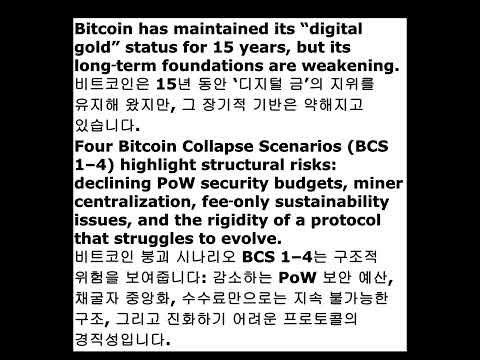
Watch the 50-second video to see why Bitcoin’s long-term risks contrast sharply with Ethereum’s growing economic role.
Beyond Bitcoin 2: Why ETH Is Becoming the Core Currency of the Digital Economy
This article is a continuation of Part 1, “Beyond Bitcoin 1: Why ETH Is Becoming the New Digital Money.” In Part 1, we explored why ETH is being revalued not as a mere tech asset but as “productive digital money.” In this Part 2, we expand the discussion by examining the structural risks Bitcoin faces in the long term and how these risks contrast with Ethereum’s design and economic role.
Bitcoin has held the status of “digital gold” for the past 15 years. However, the structural foundations supporting this status may not be sustainable in the long run. The following four Bitcoin Collapse Scenarios (BCS) highlight the key risks that could undermine Bitcoin’s competitiveness in the future digital economy.
Bitcoin Collapse Scenarios (BCS 1–4)
BCS 1 — Slowing Price Growth → PoW Security Budget Breakdown
If Bitcoin’s price fails to double every four years, the halving cycles sharply reduce the security budget, weakening the PoW model.
BCS 2 — Costs > Revenue → Miner Exit → Centralization & Collusion Risk
When energy costs exceed mining revenue, miners leave the network, increasing the risk of collusion among the remaining few and undermining decentralization.
BCS 3 — Near‑Zero Block Rewards After 2040 → Transaction Stagnation → Scalability Failure
Once block rewards approach zero, the network must rely solely on fees, threatening both scalability and economic viability.
BCS 4 — No Economic Incentives → Full Node Abandonment → Security & Decentralization Collapse
Without economic incentives, full nodes may decline over time, weakening the network’s decentralization and security.
These four scenarios stem from Bitcoin’s PoW structural limitations, lack of scalability, weak economic incentives, and resistance to protocol evolution. Let’s now compare Bitcoin and Ethereum across key dimensions of the digital economy.
1) How Each Network Sustains Its Security Budget
Bitcoin: A Security Model Weakening with Each Halving
- PoW security depends on block rewards and transaction fees.
- Halvings reduce the security budget → increases BCS 1, 2, and 3 risks.
- Rising energy costs push miners out, increasing centralization risk.
- Long‑term reliance on fees alone is economically fragile.
Ethereum: A Sustainable PoS‑Based Security Model
- PoS security scales with the economic value staked on the network.
- Attacks result in slashing, destroying the attacker’s stake.
- Energy consumption dropped by ~99.95% after The Merge.
- Security budget is supported by staking rewards, L1/L2 fees, and MEV.
- BCS 1–4 type risks are structurally mitigated or eliminated.
2) RWA, DeFi, and Payment Infrastructure of the Digital Economy
Bitcoin: Limited to the Role of Digital Gold
- Lacks native smart contract capabilities for RWA, DeFi, or complex settlement.
- Lightning Network has not scaled into a robust global payment infrastructure.
- This limitation is directly related to BCS 3 (scalability failure).
Ethereum: Core Infrastructure for the On‑Chain Economy
- Leading platform for RWA, DeFi, and stablecoin settlement.
- By 2025, L2 transactions reached about 35 million per day.
- L2 annual fee revenue is estimated at around $2.7 billion.
- Global institutions choose Ethereum as the primary RWA issuance platform.
- USDC, USDT, PYUSD and other major stablecoins rely on Ethereum as a settlement layer.
3) Scalability to Replace Traditional Financial Infrastructure
Bitcoin: Structural Scalability Limitations
- L1 throughput is limited to roughly 3–7 transactions per second.
- Lightning Network has not achieved meaningful, reliable global scale.
- Insufficient to replace existing financial rails → exacerbates BCS 3 risk.
Ethereum: L1–L2 Division Enables Massive Scalability
- L1 functions as the security and final settlement layer.
- L2 handles high‑volume, low‑cost transactions.
- After Dencun, L2 fees dropped to under $0.01 per transaction.
- L2 transaction volume exceeds mainnet by more than 20×.
- Capable of supporting on‑chain payments, clearing, collateral, and lending at scale.
4) Security in the Age of Quantum Computing
Bitcoin: Vulnerable Due to Cultural Resistance to Change
- Strong ossification culture makes major protocol upgrades difficult.
- Adopting quantum‑resistant cryptography is politically and technically challenging.
- ECC‑based wallets are vulnerable to future quantum attacks.
- Combined with BCS 4 (node decline), this increases long‑term fragility.
Ethereum: Actively Preparing for a Post‑Quantum Future
- Maintains an explicit roadmap toward quantum‑resistant cryptography.
- PoS allows more flexible key rotation and upgrade mechanisms.
- An active research and development culture enables adaptation to new threats.
5) Cultural Resistance to Protocol Evolution (Ossification)
Bitcoin: A Protocol That Can Barely Evolve
- Scalability and security upgrades are extremely hard to deploy.
- This rigidity amplifies all BCS 1–4 risks over time.
Ethereum: Continuous Upgrades and Long‑Term Viability
- Successfully transitioned from PoW to PoS.
- Implemented the Dencun upgrade to scale L2.
- Pursues zkEVM, privacy, and post‑quantum roadmaps.
- Designed as a protocol that can evolve with the digital economy.
Conclusion: BTC Is Digital Gold, ETH Is Productive Money + Financial Infrastructure
As illustrated by BCS 1–4, Bitcoin faces structural limitations in security budget sustainability, scalability, economic incentives, and protocol evolution.
Ethereum, by contrast, combines PoS security, L2‑driven scalability, RWA/DeFi/payment infrastructure, a quantum‑aware roadmap, and a culture of continuous upgrades to become both productive money and foundational financial infrastructure for the digital economy.
The future of the digital economy requires more than a passive store of value. It demands a platform that can host real economic activity at scale. In that world, the asset at the center is no longer “dead capital” like non‑productive gold, but productive, scalable digital money — ETH.
Younchan Jung
Researcher exploring structural shifts in AI, blockchain, and the on‑chain economy.
If you would like to read this article in Korean, please click the button below.